FirstLight Compose · AI product engineering
Design a real product from a sentence.
The electronics, mechanical, firmware, sourcing, and validation work of a small hardware team, the part that normally takes months and a five-figure budget, in about seven minutes. You review what it flags. It does the rest.
Describe what you're building in plain language. Compose designs and routes the board, wraps it in an enclosure that actually fits, runs real physics simulation, generates firmware for the board that shipped, and hands you the manufacturing, sourcing, and test plans to build it. It is proven today on precision measurement and sensor boards, an MCU with analog and I²C front ends on rigid FR-4.
Start with a free Pro trial on your own model key. Open Compose →
- 0 DRC errors, gated and never assumed
- 8 engineering disciplines, one run
- ~7 min prompt to product package
Integrations
Every run drives the same tools professional hardware teams already trust.











Enclosure CAD is driven live in Onshape and boards only go green on real KiCad DRC. Fab quotes come from PCBWay and JLCPCB's own price APIs; sourcing checks live distributor stock.
Simulation
Six real solvers, plus gmsh meshing, behind the physics gates. Compose runs the analyses each design needs, and nothing goes green without the solves it calls for.


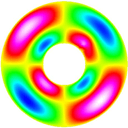


When a design calls for them, SciPy runs the thermal and modal FEM; gmsh meshes and CalculiX solves the 3D FEA. OpenFOAM runs the natural-convection CFD, Elmer the cavity acoustics, openEMS the antenna FDTD, and ngspice sweeps the rail decoupling network. Every result is labeled with the tool and fidelity that produced it, and a gate that fails says so.
Who it's for
Built for the people actually shipping hardware.
Hardware startups
Reach a manufacturable first product without hiring a full electrical, mechanical, and firmware team on day one. Ship your first board this month, not next quarter, and put your budget into what makes you different.
Solo & indie builders
Turn an idea into routed copper, a real enclosure, and a fab package in an afternoon. The disciplines you don't have in-house are covered, and gated on real checks, so what you send to fab is buildable, not a guess.
Product & engineering teams
Kill the expensive early spins. Explore ten design directions before lunch, each one validated in simulation, so the version your EE picks up is already close. Defense and space teams get an ITAR-ready deployment.
AI can describe a circuit.
Getting to a product you can build is the hard part.
Schematic ideas are cheap. Turning one into routed copper, an enclosure that actually fits it, firmware for the board that shipped, and the manufacturing, sourcing, and test plans to build it still means weeks across five disciplines, or a contract team. Compose closes that gap in a single continuous run, and it does it honestly. Every stage is gated on real checks, from KiCad DRC to geometric fit to finite-element physics, and a gate that fails says so instead of shipping a green lie.
Describe it. Compose builds it. A manufacturable board, its enclosure, firmware, and the plans to ship it.
How it works
From a prompt to a manufacturable board, in one run.
A short design interview fills in what matters, like size, volume, and connectivity. Then the full pipeline runs in front of you, live logs streaming, gated at every stage. The industrial design drives the mechanical CAD; the board takes the enclosure's shape; the firmware targets the board that shipped. Nothing goes green unless its real checks pass. When physics says a design runs hot, you find out before tooling, not after.
Manufacturable fab package
Gerbers, drill, pick-and-place, and BOM, routed and gated on real KiCad DRC. A board only goes green when the checks actually pass.
Enclosure CAD
A two-shell enclosure generated to match the industrial design, with bosses aligned to the board's mounting holes, fit-checked and exported as real STEP.
Boards shaped to the product
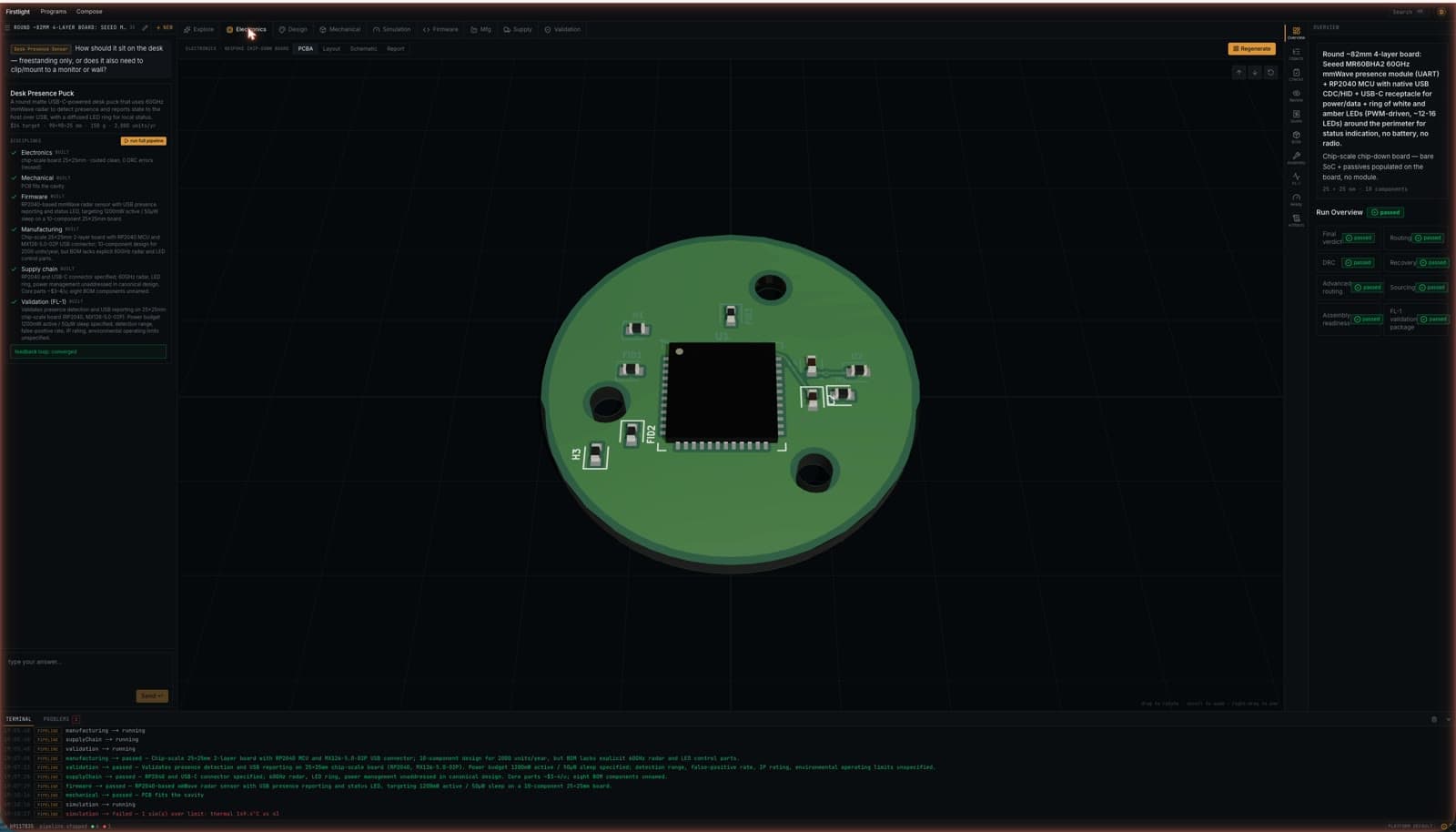
A round product gets a circular board with mounting holes on a bolt circle. The PCB follows the enclosure, not the other way around.
Physics simulation
Real solves, honestly labeled and run as each design needs them: FEM thermal and modal, 3D FEA in CalculiX, natural-convection CFD in OpenFOAM, cavity acoustics in Elmer, antenna FDTD in openEMS, rail impedance in ngspice. A design that runs hot fails in simulation before anyone tools a mold.
Firmware
A compiled firmware image that targets the board that actually shipped, with the peripheral map, power states, and USB reporting.
Manufacturing, sourcing & test
An NPI package sized to your volume, a sourcing plan with real parts and lead-time risks called out, and an FL-1 validation test plan with the gaps flagged, never papered over.
Design and validation are one system. Testability is built in before the board is ever fabricated.
It doesn't stop at the board. Manufacturing, sourcing, and test plans are generated from the same design. Readable, honest, and flagged where an engineer is still needed.
Open Compose →Version one is the start, not the answer. Describe a change in plain language. Compose routes it, rebuilds only what it touches, and shows you the diff.
Every build is a revision of a durable product. Pin the decisions you want kept, a part, a dimension, a budget, and every rebuild must keep them. Pins are verified against the built design, never just trusted.
A work queue, not a report
Every honest flag the pipeline raises, a failed simulation, an unspecified part, a fit risk, becomes an actionable item. Click it, answer one question, and the fix routes back through the pipeline.
Built for the whole team
Share a product read-only with comments anchored to the exact artifact, the fit check, a BOM line, a thermal result. Request approval on a revision and it lands in the enterprise console with evidence attached.
Hand edits round-trip
Export the STEP or the KiCad board, edit it by hand, and import it back as a revision. Compose strips exactly the claims your edit invalidated, and nothing regenerates over your work.
Every revision is sealed.
Compose records each build as a signed session on the open source Checkpoint Protocol. An Ed25519 signed snapshot chain ties every revision to the prompt, the artifacts, and the gate results that produced it, and the whole history is verifiable on demand. A seal is provenance, not approval. A failed check seals as failed.
verify-history · all accepted snapshots have valid seals · 0 unsignedPricing
Pay for outcomes, not tokens.
FirstLight compresses years of product development into minutes. Bring your own model key, and a plan buys platform runs, priced by board size — so runs are deliberately valuable. Start Pro with a free trial; ship on a plan, and license annually for a team.
Pro
$49/month
- Starts with a free trial
- Bring your own model key, every model
- Full exports — Gerbers, BOM, CAD, firmware
- Priority build queue, revision history
Studio
$499/month
- For teams shipping products regularly
- Team seats & shared workspace
- Highest build priority
- Principal-EE design reviews
Enterprise
Custom/year
- Private / on-prem deployment
- Your designs are never used for training
- SSO, SLA, custom part libraries
- ITAR-ready for defense & space
Coming next · FirstLight FL-1
The machine that brings your board to life.
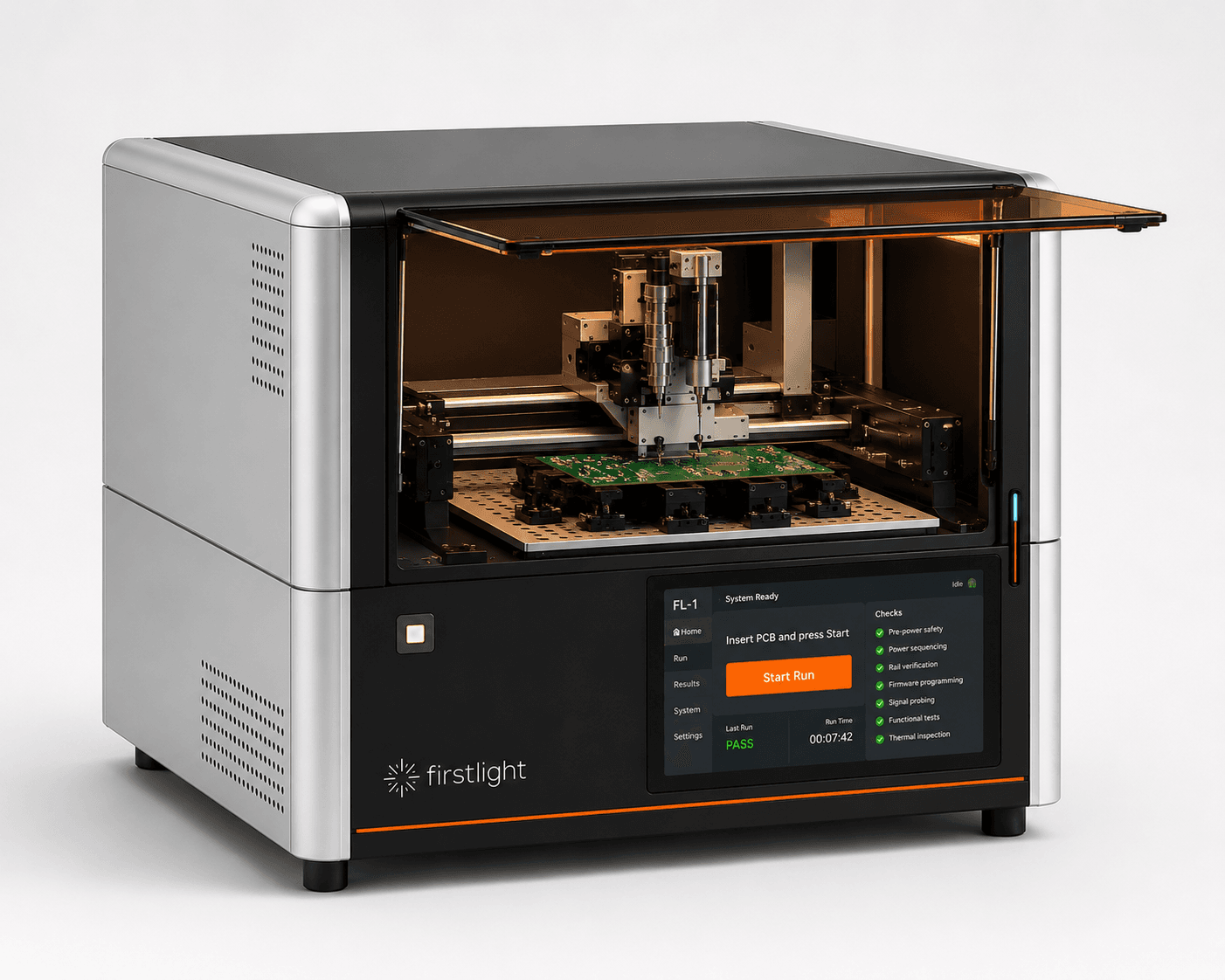
Compose designs the board. FL-1 validates the physical one. Insert the assembled PCB, press start, and the machine autonomously powers it up, probes it, and tells you exactly what works and what failed, using the test plan Compose generated.
- Programmable multi-rail power & electronic load
- Oscilloscope, logic analyzer & DAQ
- 6.5-digit digital multimeter
- Automated precision probing & Kelvin 4-wire measurement
- UART, I²C, SPI, USB, Ethernet, CAN-FD testing
- Machine vision & thermal inspection
FL-1 is in engineering validation. Reserve your place in line for the first production units.
And FL-1 itself was designed in Compose. We used our own product to build the machine that tests hardware. Read the case study →
First board, first light.
FL-1 in motion, a CAD-rendered concept film from the production design model. Canopy, fixture drawer, and an autonomous probing run.